Morgan Krause · 6 October 2026
Electromagnetic Shifts in Ocean Waters Inspire Updated Marine Protection Approaches
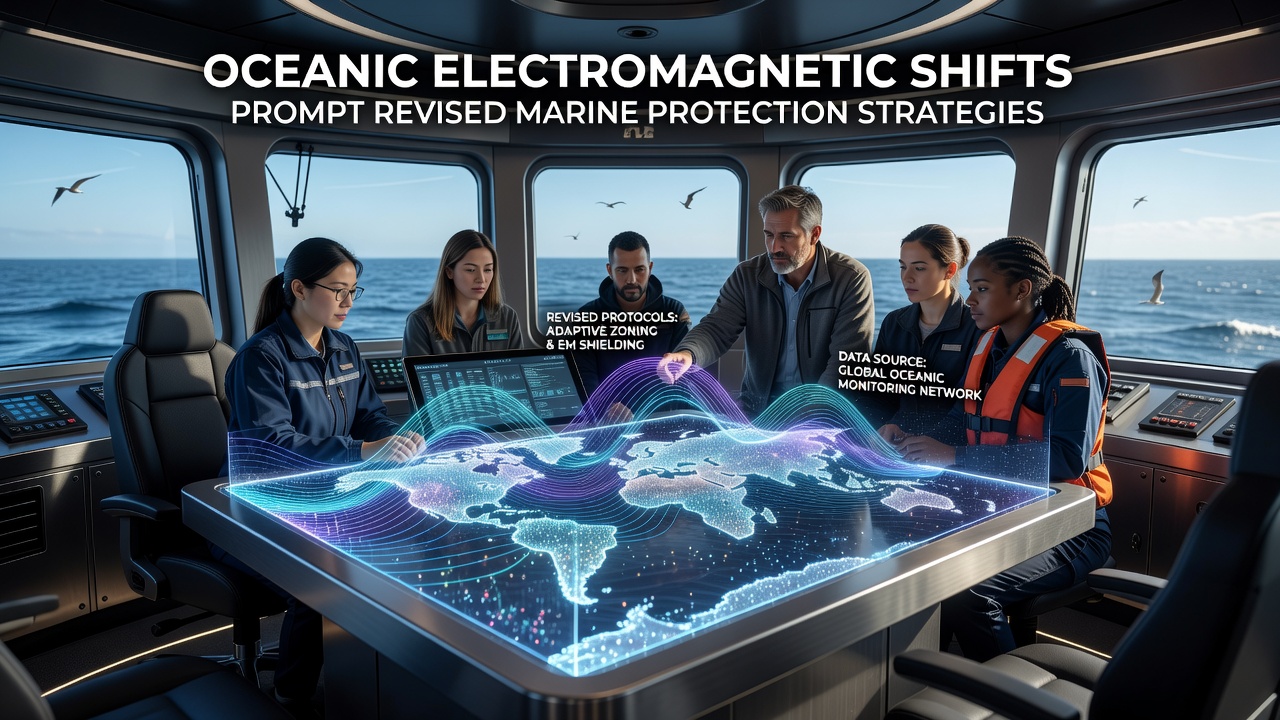
Electromagnetic fluctuations across ocean basins have drawn attention from marine researchers since patterns began diverging from historical baselines in recent years, and data gathered through October 2026 confirmed accelerated changes in several key regions including the North Atlantic and western Pacific, where field intensity readings showed deviations of up to 12 percent compared with measurements from a decade earlier. These variations stem from a combination of natural geomagnetic processes and increasing human infrastructure such as subsea power cables, which generate localized fields that interact with the planet's broader magnetic environment. Observers note that many migratory species rely on Earth's magnetic cues for navigation, so shifts of this magnitude can alter established routes and feeding grounds, prompting agencies to revisit how protected zones are defined and monitored.
Mapping the Changes in Marine Electromagnetic Environments
Research teams have deployed arrays of magnetometers and conductivity sensors along continental shelves and mid-ocean ridges to capture high-resolution profiles, while satellite magnetometry provides complementary coverage over large areas. According to reports compiled by the National Oceanic and Atmospheric Administration, certain hotspots now exhibit rapid daily fluctuations that coincide with tidal cycles and solar activity peaks, creating dynamic zones where field strength can vary by several microteslas within hours. European Environment Agency analysts have tracked similar anomalies in the Baltic and Mediterranean basins, where dense cable networks amplify local effects. Those who've studied these datasets observe that the spatial distribution of anomalies often aligns with bathymetric features such as seamounts and trenches, suggesting geological conductivity plays a role alongside anthropogenic sources.
Consequences for Species That Navigate by Magnetic Cues
Sea turtles, certain shark species, and migratory cetaceans demonstrate behavioral adjustments when exposed to altered magnetic gradients during controlled experiments, and field observations from October 2026 indicated that loggerhead turtle nesting sites in the western Atlantic have shifted poleward by roughly 45 kilometers over five seasons. Studies conducted by the Australian Institute of Marine Science documented corresponding changes in humpback whale migration timing, with pods arriving at feeding grounds several weeks earlier than historical averages in areas where electromagnetic intensity had increased. These adjustments carry downstream effects on prey populations and coastal ecosystems, because altered arrival times can desynchronize breeding cycles with plankton blooms. Evidence suggests that juvenile fish settling on reefs also orient differently under modified fields, which may influence recruitment success in already stressed coral habitats.

Adjustments to Protection Frameworks and Monitoring Protocols
Regulatory bodies have begun incorporating electromagnetic data layers into marine spatial planning tools, and several nations updated their conservation area boundaries during late 2026 to account for new magnetic corridors identified through integrated modeling. Canada’s Department of Fisheries and Oceans revised its offshore protection network to include buffer zones around high-gradient zones, while New Zealand authorities expanded monitoring requirements for cable installation projects that cross known migration pathways. These revisions emphasize adaptive management cycles that revisit boundaries every two years rather than fixed decadal reviews, allowing quicker response when field measurements exceed established thresholds. Industry groups working with subsea energy developers now coordinate pre-installation surveys that quantify expected electromagnetic contributions, and permitting processes require mitigation designs such as cable burial depths or shielding materials that reduce field leakage.
Integration of Real-Time Data Streams into Decision Making
Autonomous underwater vehicles equipped with miniaturized magnetometers transmit readings to shore-based centers, enabling near-real-time alerts when anomalies exceed modeled ranges, and this capability has allowed rapid deployment of temporary exclusion zones around sensitive calving areas during peak migration windows. University-led programs in Japan and Norway have piloted machine-learning classifiers that correlate electromagnetic signatures with acoustic detections of marine mammals, improving the precision of dynamic management areas. Data sharing agreements between regional fisheries organizations facilitate cross-border coordination, because magnetic features do not respect national boundaries and species traverse multiple jurisdictions during annual cycles. The result is a more responsive protection system that treats electromagnetic conditions as a variable input rather than a static background factor.
Conclusion
Electromagnetic shifts in ocean environments continue to reshape how protection strategies are formulated, with updated mapping, species-specific research, and adaptive regulatory frameworks now guiding conservation actions across multiple ocean basins. Continued investment in sensor networks and international data exchange will determine how effectively these revisions maintain ecological connectivity amid ongoing field variations.